Research
1. End-of-Life Lithium-ion Battery Recycling and Recovery (Green Metal Production)
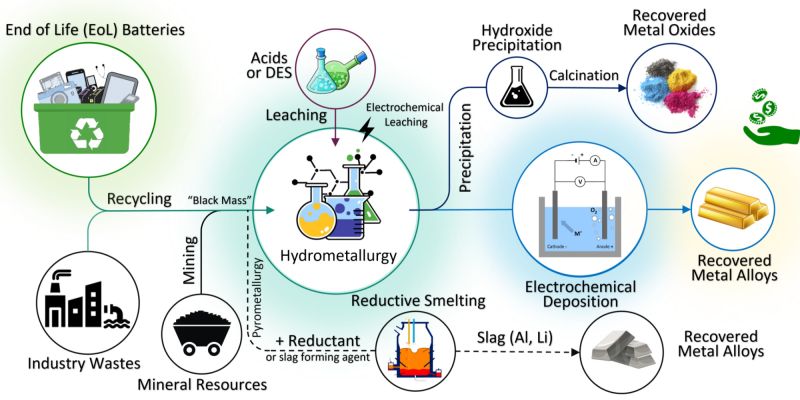
Our research group is focused on developing advanced methods for recycling the growing number of spent lithium-ion batteries (LIBs), which are widely used in electric vehicles, portable electronics, and energy storage systems. The increasing accumulation of these spent LIBs poses significant environmental hazards and underscores the urgent need to recover valuable metal resources. However, the diverse and complex composition of cathode materials, along with the presence of unknown elements introduced during production and use, makes recycling both challenging and costly.
To address these challenges, we are working on creating a more efficient and cost-effective recycling process by integrating hydrometallurgical and electrochemical methods. Traditional recycling approaches, such as hydrometallurgy and pyrometallurgy, can be energy-intensive and less sustainable. Our strategy emphasizes direct recycling, where cathode and anode materials are separated and regenerated without breaking them down into elemental forms. This approach preserves the particle morphology and crystalline structure of the materials, allowing them to be directly reused in the production of new LIBs.
Additionally, we are investigating electrochemical methods that offer high selectivity for specific metal ions and are environmentally friendly. By combining these electrochemical techniques with hydrometallurgical processes, our aim is to develop a comprehensive LIB recycling solution that maximizes leaching efficiency, reduces costs, and enhances environmental sustainability. This integrated approach addresses the limitations of existing methods and contributes to a more circular economy in battery production and use.
2. Green Hydrogen Production Through Water Electrolysis
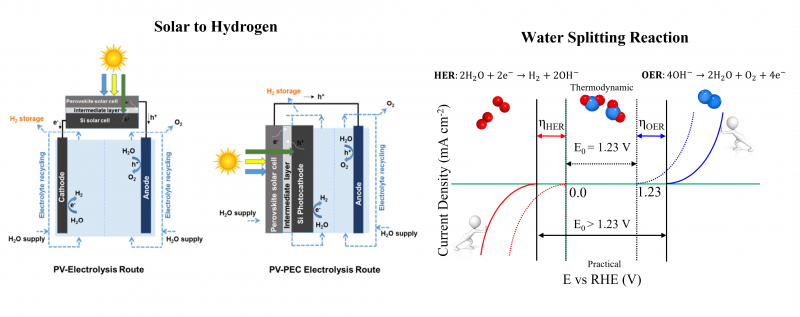
Green hydrogen production is a pivotal solution in the transition towards sustainable energy systems due to its potential to store and deliver renewable energy in a versatile, clean form. Producing hydrogen through water electrolysis, where electricity from renewable energies splits water into hydrogen and oxygen, offers a zero-carbon emission pathway critical for decarbonizing various industrial sectors and transport systems. However, the widespread adoption of green hydrogen is currently hindered by two primary challenges: high production costs and the need for efficient electrocatalysts. The development of efficient electrocatalysts is crucial for enhancing the water electrolysis process. Current electrocatalysts often require rare, expensive materials and may not operate efficiently under the demanding conditions of high-volume hydrogen production. Research in this area focuses on innovating catalysts that are not only more efficient but also made from abundant and sustainable materials to improve the overall sustainability and feasibility of green hydrogen production.
3. CO2 Hydrogenation (Conversion & Utilization) and Mechanism Study via In-situ/operando Spectroscopy
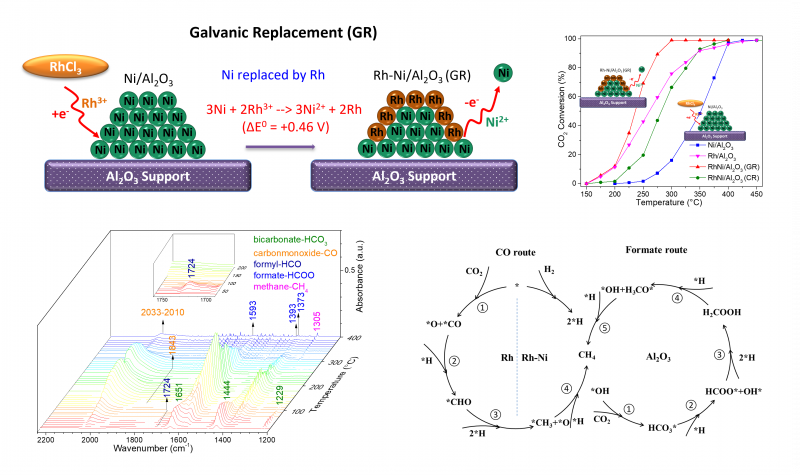
We are focusing on advancing CO2 conversion and utilization through CO2 hydrogenation, a critical approach to addressing climate change and promoting energy sustainability. We are dedicated to the smart design of catalyst materials that can efficiently convert CO2 into valuable chemicals and fuels, such as methane, methanol, and other hydrocarbons. By leveraging advanced in-situ tools, we study the reaction mechanisms at the molecular level, gaining insights that drive the optimization of catalytic processes. Our goal is to enhance the efficiency, selectivity, and scalability of CO2 hydrogenation, making it a practical solution for large-scale applications in the circular carbon economy. Through these efforts, we aim to reduce CO2 emissions and create sustainable pathways for energy and chemical production.
In the field of catalysis, understanding the intricate details of reaction mechanisms is crucial for the development of more efficient and selective catalysts. In-situ/operando spectroscopy has emerged as a powerful suite of techniques that allow us to observe and analyze the dynamic changes in catalysts during the actual chemical reactions. In-situ Diffuse Reflectance Infrared Fourier Transform Spectroscopy (DRIFTS), in-situ Raman Spectroscopy, and in-situ X-ray Absorption Spectroscopy (XAS) are among the key methods employed to gain insights into the active sites, intermediate species, and reaction pathways. These techniques provide real-time, molecular-level information that is vital for deciphering the complex processes occurring at the catalyst surface, thus offering a more complete understanding of catalytic behaviors under realistic operational conditions.