2025 news
The Nanostructured Interfaces and Materials Science (NIMS) Group was renamed as the Caruso Nanoengineering Group in November 2020.
CNG team secures funding for nanoparticle therapy research for treating blood cancers
December 2025
Congratulations to CNG team on being awarded >$1M from the NHMRC under the Ideas Grants program to support research on the development of improved anticancer drugs for the treatment of blood cancers. The project is being led by Dr. Christina Cortez-Jugo, A/Prof. Francesca Cavalieri and Dr. Roop Bhangu, and conducted in collaboration with researchers at the Walter and Eliza Hall Institute of Medical Research and Aculeus Therapeutics. This research project will offer safer ways to administer treatment and expand options for thousands of Australians and people across the globe that are impacted by blood cancers.
The NHMRC Ideas Grants program is designed to support innovative and creative health and medical research projects.
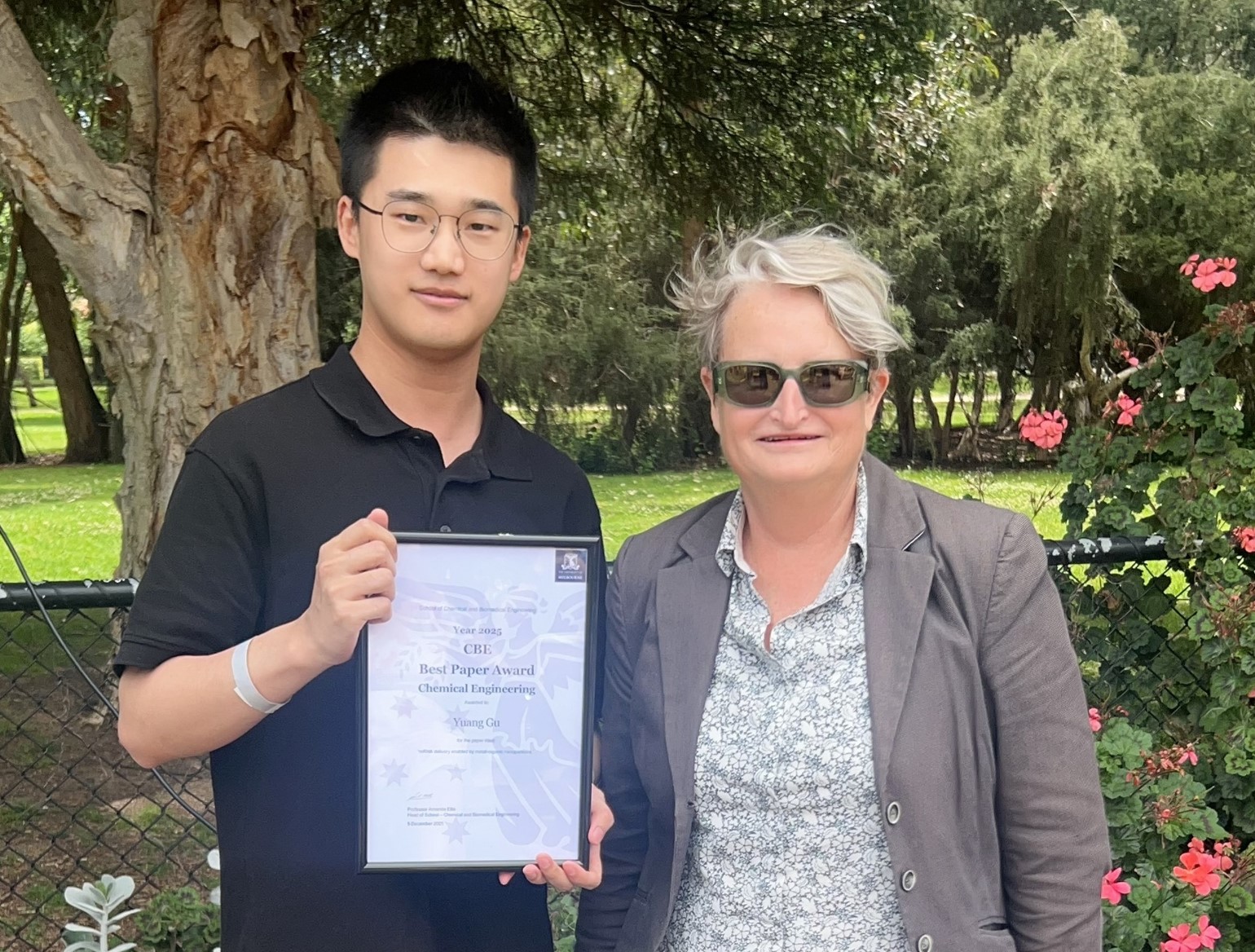
CNG PhD student scores Best Paper Prize
December 2025
Congratulations to Yuang Gu on receiving the 2025 Best Paper Award in Chemical Engineering for his paper entitled “mRNA Delivery Enabled by Metal–Organic Nanoparticles”. This co-first authored paper by Yuang Gu and Jingqu Chen was published in Nature Communications.
This study demonstrates the application of metal–phenolic networks in the design of a modular and versatile nanoparticle platform for both in vitro and in vivo mRNA delivery. Importantly, the designed nanoparticle platform is non-cationic, thereby circumventing challenges in limited organ tropism faced by current mRNA delivery platforms, and mRNA delivery to specific organs can be readily tuned simply by varying the nanoparticle building blocks.
The CBE Graduate Researcher Best Paper Prize is an annual initiative dedicated to recognising and celebrating the exceptional research contributions of the School’s Graduate Researchers and the dissemination of their work through peer-reviewed publications.
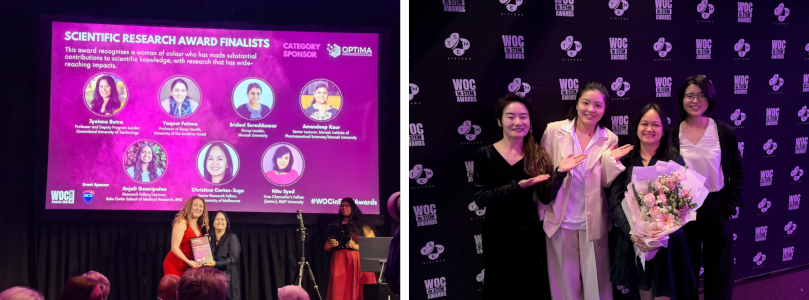
CNG research fellow Christina Cortez-Jugo named as a finalist for Women of Colour in STEM Award
October 2025
Congratulations to CNG research fellow Dr Christina Cortez-Jugo on being selected as a 2025 Women of Colour in STEM Award (Scientific Research Award) finalist in Scientific Research in recognition of her substantial contributions to scientific knowledge and research impact in STEM.
The Women of Colour in STEM Awards is an initiative led by STEM Sisters to recognise and honour the remarkable achievements of women of colour who are pioneering innovation and driving change in science, technology, engineering, and mathematics (STEM) fields. The Women of Colour in STEM Awards honour excellence across 15 categories, including Leadership, Scientific Research, Rising Star, and PhD Scholar.
CNG honorary research fellow scores Best Poster Award
September 2025
Congratulations to CNG honorary research fellow Dr Soraia Fernandes on winning a Best Poster Award at the 9th Nano Today Conference held in September 2025 in Singapore. Soraia’s poster was entitled Understanding the interaction of therapeutic nanoparticles with cancer-associated fibroblasts and the extracellular matrix.
CNG postdoc scores Best Postdoctoral Presentation Award
September 2025
Congratulations to CNG postdoc Dr Jingqu Chen on winning the Best Postdoctoral Presentation Award at the 4th Australasian RNA Biology and Biotechnology (A-RNA) Association Conference held in September 2025 in Sydney. Jingqu’s talk was entitled Bioactive Metal–Organic Nanoparticles: A Versatile Platform for RNA Delivery.

CNG article in ACS Nano highlighted on supplementary cover
August 2025
A collaborative research work between CNG and Dr. Thomas Bonnard and his team at Normandie Université has been highlighted as a supplementary cover of ACS Nano. The research article entitled “Monitoring Whole-Body Inflammation with Gallium-68-Labeled Polydopamine Iron Oxide Particles via Hybrid Immuno-PET-MRI” presents the development of a bimodal imaging probe for inflammation diagnosis and monitoring, particularly in the context of lung and kidney disorders. The probe consists of micrometer-sized polydopamine matrix-based magnetic particles functionalized with antibodies targeting vascular cell adhesion molecule-1 and radiolabeled with gallium-68 radioisotope, affording inflammation detection via positron emission tomography (immuno-PET) and high-resolution mapping via magnetic resonance imaging (immuno-MRI).
CNG PhD student Matthias Pichler, winner of 3MT Competition
June 2025
Congratulations to Matthias Pichler on winning the Three Minute Thesis (3MT) Competition (for Biomedical Engineering) for his project entitled “Wrapping Cells”.
Matthias is currently pursuing his PhD studies under the primary supervision of A/Prof. Daniel Heath and co-supervision of Prof. Frank Caruso and Dr Omid Mazaheri.
As a finalist, Matthias will represent the School of Biomedical and Chemical Engineering in the Faculty of Engineering and Information Technology’s 3MT Competition. Best of luck Matthias!
CNG PhD student Phoebe Irawan awarded a McPherson and Invergowrie Scholarship
June 2025
Congratulations to Phoebe Irawan on being awarded a McPherson & Invergowrie Foundation PhD Scholarship for Women in support of her postgraduate studies in the field of Engineering.
The Invergowrie Foundation’s mission is to advance the education of girls and women in Victoria (Australia) particularly in STEM education. The Foundation awards grants that make a significant impact enabling access, promoting excellence, advancing leadership, and supporting research.
CNG research in the spotlight
April 2025
Two of CNG’s research articles have been ranked among the top 10% most-viewed articles published by Wiley journals in 2023.
The first CNG article entitled ‘Direct Assembly of Metal‐Phenolic Network Nanoparticles for Biomedical Applications’, which was published in Angewandte Chemie in Oct 2023, presents a simple and versatile strategy for assembling metal–organic networks into nanoparticles without the use of templating agents, seeding agents, or harsh synthesis conditions. The strategy affords a library of metal–phenolic nanoparticles with tuneable physiochemical properties (e.g., sizes ranging from 50 to 270 nm) simply by adjusting the synthesis conditions (e.g., assembly pH, reaction time, precursor ratio, and concentration). Various functional cargoes can also be incorporated to impact the nanoparticles with biofunctionality for potential use in various biomedical applications, including cell targeting and drug delivery. This study expands the realm of the field of metal–phenolic networks and is expected to provide a guideline for the rational assembly of other highly biocompatible metal–organic nanoparticle systems.
The second CNG article entitled ‘Engineering Antimicrobial Metal–Phenolic Network Nanoparticles with High Biocompatibility for Wound Healing’ was published in Advanced Materials in Nov 2023. This work presents a simple strategy to synthesize highly biocompatible antimicrobial metal‒phenolic network nanoparticles via a one-step assembly process. The engineered nanoparticles exhibit negligible toxicity, and antimicrobial performance against drug-resistant bacteria both in vitro and in vivo. Specifically, the Cu2+-based antimicrobial metal–phenolic network nanoparticles display lower Cu2+ antimicrobial concentrations (by 10–1000 times) lower than most reported nanomaterials to date. The antimicrobial mechanism of the engineered nanoparticles was also investigated and identified. The excellent antimicrobial efficacy, low toxicity, and facile synthesis of the antimicrobial metal–phenolic network nanoparticles make them potentially promising for clinical applications. Notably, all components used for the nanoparticle synthesis are approved by the US Food and Drug Administration for food and medicine formulations, indicating their safety and potential for clinical translation.
CNG postdoc Dr Qingqing Fan awarded a CBE Acceleration Grant
April 2025
Congratulations to CNG postdoc Dr Qingqing Fan on being awarded an Acceleration Grant from the School of Chemical and Biomedical Engineering (CBE), The University of Melbourne, for her project entitled "Developing nanoparticle assemblies for delivery to the placenta".
This joint project between CNG and Prof. Natalie Hannan's team from the School of Medicine brings together complementary expertise in nanomaterials and maternal-fetal health. The project aims to develop next-generation nanocarriers with precise placental targeting, providing a platform for therapeutic intervention in pregnancy complications such as preeclampsia. While CNG contributes advanced materials engineering and nanoparticle design, the clinical direction and urgent therapeutic need in addressing placental dysfunction—particularly in preeclampsia, a condition responsible for over 76,000 maternal and 500,000 neonatal deaths annually—are led by Professor Hannan’s team. This project seeks to bridge this gap by engineering targeted solutions, with the goal of advancing therapies that improve outcomes in maternal and fetal health.
In line with the School’s ongoing commitment to fostering research excellence at the University, the CBE Accelerate Grant Scheme is designed to support early career researchers in advancing their research, engagement, and impact.
CNG team secures funding for mRNA delivery research
March 2025
Congratulations to CNG team on securing funding for mRNA delivery research with international collaborator Korea Institute of Geoscience and Mineral Resources (KIGAM). Prof. Frank Caruso and CNG postdoc Dr Omid Mazaheri will work alongside researchers at KIGAM to develop nanoclay-based materials for oral mRNA delivery applications.
KIGAM is a world-class R&D organization that explores geological resources to lead innovative geo-science and technology solutions in addressing global challenges.

CNG article in Nano Letters highlighted on front cover
February 2025
A collaborative article has been highlighted on the front cover of Nano Letters. This article entitled “Regulation of Cell–Nanoparticle Interactions through Mechanobiology” examines the molecular and cellular mechanobiology parameters that govern the interactions between cells and nanoparticles. Specifically, the study focuses on the role of the yes-associated protein (YAP), which is a mechanically activated transcriptional effector of the Hippo pathway, on determining the fate of cell–nanoparticle interactions. The findings show that the inhibition of YAP may be leveraged to optimize cell–nanoparticle interactions, thereby promoting the delivery of nanomedicines and improving therapeutic efficiency. The study aims to contribute to a deeper understanding of the role of cell mechanobiology pathways involved in bio–nano interactions in developing next-generation nanotherapies.