Controlled Polymerisation
Controlled radical polymerisation allows for the synthesis of polymers with predetermined molecular weight, low dispersity and well-preserved chain end functionality. Two of the primary techniques for controlled radical polymerisation are called Reversible Addition–Fragmentation chain Transfer (RAFT) polymerisation and Atom Transfer Radical Polymerisation (ATRP). The Polymer Science Group is at the cutting edge of these techniques, expanding their scope with new initiation strategies and external stimulus control such as light and sound.
Key reviews:
Jafari, V. F., Grace, J. L., Li, J., Tanaka, J., Jones, G. R., Anastasaki, A., You, W., Zhu, J., Kamigaito, M., Boyer, C. and Qiao, G. G. (2026). Beyond Traditional RAFT Polymerization: Emerging Strategies and Future Perspectives; A Third Update. Advanced Science, e20657. DOI:10.1002/advs.202520657

Nothling, MD.; Fu, Q.; Reyhani, A.; Allison-Logan, S.; Jung, K.; Zhu, J.; Kamigaito, M.; Boyer, C.; Qiao, GG. (2020) “Progress and Perspectives Beyond Traditional RAFT Polymerization” Advanced Science Wiley, 7(20), 2001656. DOI:10.1002/advs.202001656
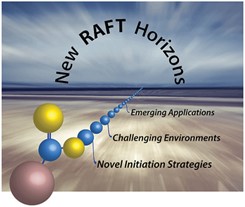
McKenzie, T. G.; Fu, Q.; Uchiyama, M.; Satoh, K.; Xu, J.; Boyer, C.; Kamigaito, M.; Qiao, G. G., “Controlled Polymerization: Beyond Traditional RAFT: Alternative Activation of Thiocarbonylthio Compounds for Controlled Polymerization” (Adv. Sci. 9/2016). Advanced Science 2016, 3, (9), 1500394 DOI: 10.1002/advs.201500394
Photoiniferter RAFT polymerisation
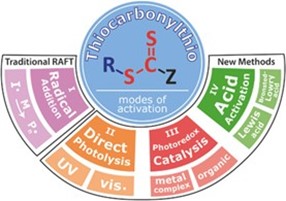
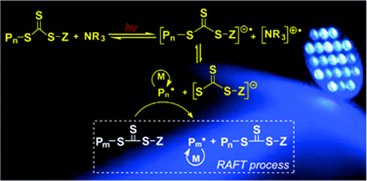
Our group pioneered photoiniferter RAFT polymerization, where the RAFT agent directly serves as both initiator and chain transfer agent under visible light in the absence of exogenous photo initiator or catalysts. In contrast to the traditional RAFT initiation using thermally labile radical initiators which is often hazardous due to unavoidable termination and initiator residues, photoiniferter RAFT polymerization offers temporal control and provides excellent control over chain-end fidelity, molecular weight, and polymer distributions. Our group have explored the viability this technique in longer wavelength, visible light and in aqueous, organic and ionic solvents. We have applied it to develop star polymer nanoparticles.
T.G. McKenzie, Q. Fu, E.H.H. Wong, D.E. Dunstan and G.G. Qiao, “Visible Light Mediated Controlled Radical Polymerization in the Absence of Exogenous Radical Sources or Catalysts”, Macromolecules, 2015, 48, 3864–3872. DOI: 10.1021/acs.macromol.5b00965

Q. Fu, T.G. McKenzie, S. Tan, E. Nam and G.G. Qiao, “Tertiary amine catalyzed photo-induced controlled radical polymerization of methacrylates”, Polymer Chemistry, 2015, 6, 5362–5368. DOI: 10.1039/C5PY00840A
McKenzie, T. G.; Wong, E. H. H.; Fu, Q.; Sulistio, A.; Dunstan, D. E.; Qiao, G. G., “Controlled Formation of Star Polymer Nanoparticles via Visible Light Photopolymerization”. ACS Macro Letters 2015, 4, (9), 1012–1016. DOI:10.1021/acsmacrolett.5b00530

Ultrasound-Induced RAFT (Sono-RAFT) polymerisation
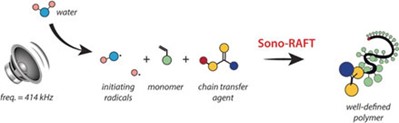
Apart from light stimuli, our group explored ultrasound-induced RAFT polymerization, which involves the application of ultrasound irradiation to generate radicals directly from the reaction solvent. Our group demonstrated the first example of sono-RAFT polymerization, where acoustic cavitation of the polymerisation solvent under high-frequency (>≈400 kHz) ultrasound causes homolysis of solvent molecules to create initiating radicals. Sonochemical initiation has since proven effective in a range of aqueous and organic systems, where hydroxyl radicals or various carbon-centred radicals constitute the predominant initiating species, respectively. This strategy has been applied to the preparation of controlled polymers with targeted self-assembly properties, yielding thermoresponsive.
Mckenzie, TG.; Colombo, E.; Fu, Q.; Ashokkumar, M.; Qiao, GG. (2017) “Sono-RAFT Polymerization in Aqueous Medium” Angewandte Chemie International Edition WILEY-V C H VERLAG GMBH. pp: 12302–12306. DOI:10.1002/anie.201706771
Fenton RAFT polymerisation
Inspired by the reported Fenton RAFT polymerization employing an ascorbic acid/H₂O₂ redox pair to produce hydroxyl radicals, our group expanded the methodology by utilizing a ferrous ion/H₂O₂ redox system. Our success in achieving rapid polymerisation reactions with narrow polydispersities encouraged us to develop this technology further, employing Fe(II)-MOF particles as heterogeneous catalysts for simplified purification. We also utilised system of glucose oxidase and the iron in sheep blood haemoglobin to afford the synthesis of ultrahigh molecular weight (UHMW) polymers in cell culture media, while not disturbing the integrity of the biomolecular components. We have also studied the treatment of cancer using this technique.
More recently, we have begun utilising a simple liquid handling robot to automatically prepare precise and high order multiblock copolymers with unprecedented livingness even after many chain extensions.
Reyhani, A.; Mckenzie, TG.; Ranji-Burachaloo, H.; Fu, Q.; Qiao, GG. (2017) “Fenton-RAFT Polymerization: An "On-Demand" Chain-Growth Method” Chemistry - A European Journal WILEY-V C H VERLAG GMBH. pp: 7221–7226. DOI:10.1002/chem.201701410
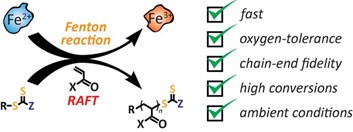
Reyhani, A.; Nothling, MD.; Ranji-Burachaloo, H.; McKenzie, TG.; Fu, Q.; Tan, S.; Bryant, G.; Qiao, GG. (2018) “Blood-Catalyzed RAFT Polymerization”, Angewandte Chemie International Edition WILEY-V C H VERLAG GMBH. pp: 10288–10292. DOI:10.1002/anie.201802544

Bacterial RAFT polymerisation
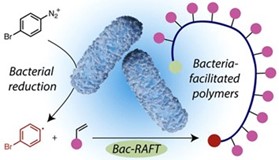
Apart from using sheep blood as the catalyst, we also take advantage of cell metabolism to achieve Bacterial (Bac)-RAFT polymerization in microenvironments. The terminal electron flux of two bacterial species, E. coli and S. Typhimurium, can be harnessed to directly reduce aryl diazonium salts to create aryl radicals within proximity to respiring microbial membranes. We demonstrated the productivity of this strategy by constructing engineered living materials via a “living” radical polymerization of a methacrylate monomer mediated by RAFT. Active metabolism was essential for the continual, sustained radical generation necessary for RAFT polymerization. The general mechanism of redox homeostasis and availability of a reducing environment in active bacterial cultures offers significant potential to expand this approach to other microbial species and alternative redox-activated chemistry.
Nothling, MD.; Cao, H.; Mckenzie, TG.; Hocking, DM.; Strugnell, RA.; Qiao, GG. (2021) “Bacterial Redox Potential Powers Controlled Radical Polymerization” Journal of the American Chemical Society AMER CHEMICAL SOC. pp: 286-293. DOI: 10.1021/jacs.0c10673