Industrial Applications
Water evaporation
Monolayers are thin films of amphiphilic molecules, which sit at the water/air interface. They offer several advantageous properties such as self-spreading across the water surface and biodegradability, while only requiring small amounts. The Polymer Science Group (PSG) is investigating the use of these films for water evaporation control.
Water loss from farm dams and storages is a significant concern. More than 1320 gigalitres of water from on-farm storages evaporate each year. This is the greatest loss of water from Australian cotton farms. For example, the cotton industry has an average evaporation loss of 25%, with some storages seeing evaporation losses as high as 45%. The economic impact of reducing even 35% of these losses would result in savings of $23,400 per hectare over a 15-year period by reducing the amount of water purchased to make up losses. There are many technologies to reduce water evaporation, such as physical covers, however these technologies typically have high capital costs and are limited to smaller storages.
The PSG has been working on this technology for several years with several field trials on water storages, as large as 5 ha. The team recently completed a three-year project as part of the Smarter Irrigation for Profit 2 <https://smarterirrigation.com.au/> where they were researching ways to reduce the impact of wind on monolayer performance. During this project the technology was tested on sections of irrigation channel in NSW and on farm dams located at the University of Melbourne - Dookie campus where the technology showed significant reductions in water evaporation.

Development of Surfaces for Industrial Anti-icing Applications
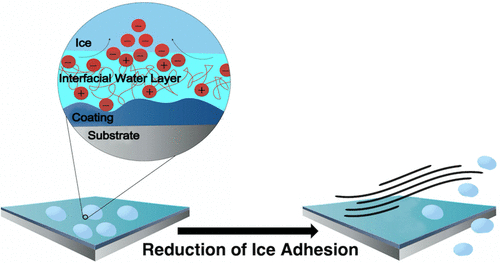
Ice build-up on solid surfaces, such as aircraft, pose a serious safety hazard and can lead to significant economic losses for a range of industries. One solution to this problem is the development of icephobic coatings. Future advancement of icephobic coatings relies on new synthetic building blocks and methods that enable added functionality, while minimising the environmental impacts and costs. The PSG anti-icing project aims to develop a novel surface modification technique that can be used for a range of industrial applications. Modification of a metal surface influences the surface properties and performance in terms of icephobicity. Structure/property investigations will probe the effect of molecular weight, reactant ratios, functional groups, and cross-linking density. A range of novel polymerization and surface modification techniques and polymer/surface characterisation techniques are utilized at our group and our collaborators’ laboratories to fabricate functional coatings for real industry applications.
Mossayebi, Z., Jafari, V. F., Gurr, P. A., Simons, R., & Qiao, G. G. (2023). Reduced ice adhesion using amphiphilic poly (ionic liquid)-based surfaces. ACS Applied Materials & Interfaces, 15(5), 7454-7465. DOI: 10.1021/acsami.2c21500
Colour-changing packaging
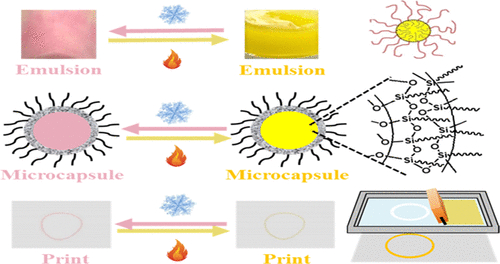
There are several mechanisms by which materials can change colour, with the main difficulty being toxicity and reversibility. The Polymer Science Group has recently published papers on non-toxic packaging for use in food products which can utilise a thermochromic or a mechnochromic mechanism – i.e. heat or physical stress.
Liu, B., Rasines Mazo, A., Gurr, P. A., & Qiao, G. G. (2020). Reversible nontoxic thermochromic microcapsules. ACS applied materials & interfaces, 12(8), 9782-9789. DOI: 10.1021/acsami.9b21330
Gas Separation Membranes
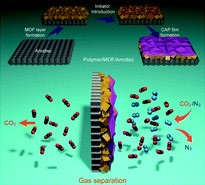
The Polymer Science group has developed several different techniques for gas separation with a focus on carbon capture, utilising thin film composites based on metal-organic framework. These membranes offer feasible, scalable ways to capture carbon dioxide and other gases with lower energy use and cost.
Xie, K.; Fu, Q.; Xu, C.; Lu, H.; Zhao, Q.; Curtain, R.; Gu, D.; Webley, PA.; Qiao, GG. (2018) “Continuous assembly of a polymer on a metal-organic framework (CAP on MOF): a 30 nm thick polymeric gas separation membrane”, Energy & Environmental Science ROYAL SOC CHEMISTRY. pp: 544–550. DOI:10.1039/c7ee02820b