Economic production of microalgal biomass requires efficient means of delivery carbon to the cells (Zheng et al. 2018). Qi Zhang and Greg Martin of the APG have helped Prof Sandra Kentish to develop a novel method for delivering CO2 directly from carbon-capture solvents using membrane technology. This method can reduce the energy associated with both delivering CO2 to the algae ponds and for regenerating the carbon-capture solvents (Qi, Martin and Kentish 2016). More recently, we have been developing immobilised enzyme technologies to enhance CO2 mass transfer to facilitate direct-air capture of CO2 using microalgae (Xu, Kentish and Martin 2021; Wang et al. 2025).
Water loss via evaporation from open ponds can represent a major issue for large-scale algae production. In collaboration with the Polymer Science Group at The University of Melbourne, we have demonstrated the effectiveness of applying monolayers to reduce evaporative losses by up to 70% (Poddar et al. 2022).
Production of nutraceuticals and high-grade biodiesel from microalgal biomass requires detailed knowledge of the lipid content of the algae and how it is affected by growth conditions (Olmstead et al. 2013).
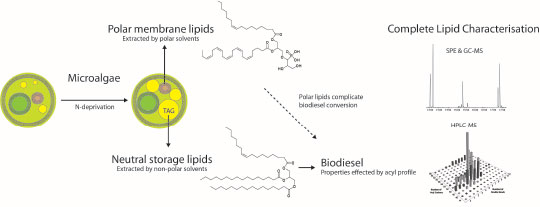
Understanding the processing and properties of algae-derived biodiesel requires quantitative information of the acyl chains associated with different lipid classes. In collaboration with Metabolomics Australia and CNRS in France, GC-MS and HPLC-MS techniques were used to obtain new information on alterations to lipid metabolism occurring in Nannochloropsis sp. and Chlorella sp. during nitrogen starvation (Martin et al. 2014). More recently, we have collaborated with A/Prof Suleria to study bioactive compounds in microalgae more broadly (Zhou et al. 2023).
A major challenge for microalgae production is the efficient harvesting of microscopic cells. Filamentous algae are larger and much easier to harvest, presenting a major advantage for applications such as wastewater treatment (Liu et al. 2020). However, less is understood about how to maximise the efficiency of filamentous algae growth, which is complicated by the occurrence of floating or subsurface mats. The APG has studied various aspects of filamentous algae production including provision of nitrogen (Liu et al. 2023) and carbon (Liu et al. 2024) and how to mathematically describe the influence of light and temperature (Pitawala et al. 2023, 2024, 2025).
References
Wang, R.-L., Li, M.-J., Martin, G.J.O., Kentish, S.E. (2025). Enhancing direct air carbon capture into microalgae: A membrane sparger design with carbonic anhydrase integration. Algal Research, 85, 103875.
Pitawala, S., Scales, P.J., Martin, G.J.O. (2025). A new modeling approach for predicting the growth of filamentous algae in outdoor algae-based wastewater treatment systems. Biotechnology and Bioengineering, 122(5): 1202-1217.
Pitawala, S., Trifunovic, Z., Crosbie, N.D., Scales, P.J., Martin, G.J.O. (2024). Biochemical changes due to photothermal acclimation of Oedogonium and associated implications for photosynthetic growth and biomass utilisation. Algal Research, 82, 103666.
Liu, J., Crosbie, N.D., Scales, P.J., Martin, G.J.O. (2024). Organic carbon utilisation by the filamentous alga Tribonema. Journal of Applied Phycology, 36:2069-2081.
Pitawala, S., Kim, T.J., Scales, P.J., Martin, G.J.O. (2024). Time-dependent inhibition of photosynthetic activity in filamentous alga Oedogonium and its implications for outdoor cultures. ACS Sustainable Chemistry and Engineering, 12(40), 14902-14909.
Pitawala, S., Trifunovic, Z., Steele, J.R., Lee, H.-C., Crosbie, N.D., Scales, P.J., Martin, G.J.O. (2023). Variation of the photosynthesis and respiration response of filamentous algae (Oedogonium) acclimated to averaged seasonal temperatures and light exposure levels. Algal Research, 74, 103213.
Liu, J., Pemberton, B., Scales, P. J., Martin, G.J.O. (2023). Ammonia tolerance of filamentous algae Oedogonium, Spirogyra, Tribonema and Cladophora, and its implications on wastewater treatment processes. Algal Research, 72:103126.
Zhou, L., Duan, X., Li, K., Hill, D.R.A., Martin, G.J.O., Suleria, H.A.R. (2023). Extraction and characterization of bioactive compounds from diverse marine microalgae and their potential antioxidant activities. Chemistry & Biodiversity, 20: e202300602.
Poddar, N., Scofield, J., Shi, S., Prime, E.L., Kentish, S.E., Qiao, G.G., Martin, G.J.O. (2022). Evaporation reduction and salinity control in microalgae production ponds using chemical monolayers. Algal Research, 66, 102783.
Xu, X., Kentish, S.E., Martin, G.J.O. (2021). Direct Air Capture of CO2 by Microalgae with Buoyant Beads Encapsulating Carbonic Anhydrase. ACS Sustainable Chemistry and Engineering, 9(29), 9698-9706.
Liu, J., Pemberton, B., Lewis, J., Scales, P.J., Martin, G.J.O. (2020). Wastewater treatment using filamentous algae - A review. Bioresource Technology, 298, 122556.
Zheng, Q., Xu, X., Martin, G.J.O., Kentish, S.E. (2018). Critical review of strategies for CO2 delivery to large-scale microalgae cultures. Chinese Journal of Chemical Engineering 26(11), 2219-2228.
Q. Zheng, G.J.O. Martin, S.E. Kentish (2016). Energy efficient transfer of carbon dioxide from flue gases to microalgal systems, Energy & Environmental Science, 9 1074–1082.
G.J.O. Martin, D.R.A. Hill, I.L.D. Olmstead, A. Bergamin, M.J. Shears, D.A. Dias, S.E. Kentish, P.J. Scales, C.Y. Botté, D.L. Callahan (2014). Lipid profile remodeling in response to nitrogen deprivation in the microalgae Chlorella sp. (Trebouxiophyceae) and Nannochloropsis sp. (Eustigmatophyceae), PlosOne, 9 e103389.
I.L.D. Olmstead, D.R.A. Hill, D.A. Dias, N.S. Jayasinghe, D.L. Callahan, S.E. Kentish, P.J. Scales, G.J.O. Martin (2013). A quantitative analysis of microalgal lipids for optimization of biodiesel and omega-3 production, Biotechnology and Bioengineering, 110 2096–2104.